Utilities across the country are navigating a familiar tension: load growth is accelerating, capacity margins are tightening, and customer bills are increasing. Solutions that can be deployed quickly and perform predictably to meet grid needs are essential—and we need more of them, fast. The Demand Stack is Uplight’s answer to the capacity challenge—cost-effective, predictable, and able to adapt to utilities’ specific needs.
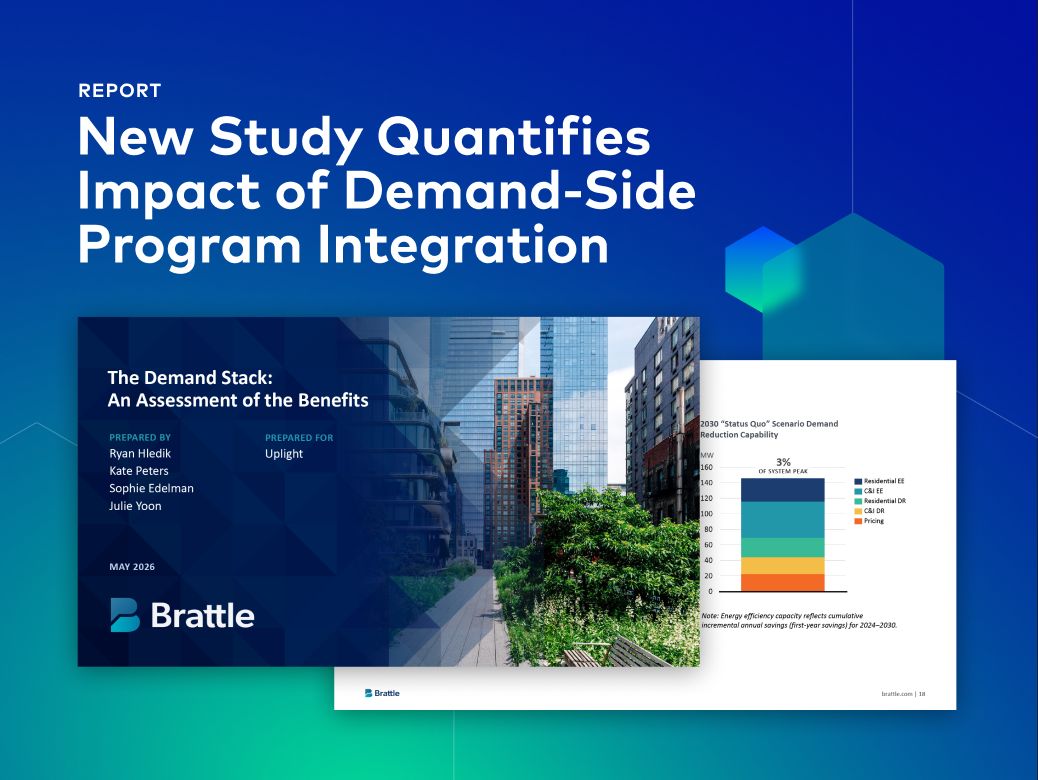
But, can we truly rely on demand-side flexibility when the grid needs capacity most? Uplight partnered with The Brattle Group to quantify the benefits of transforming siloed demand-side programs into a cohesive portfolio of predictable, planning-grade capacity using the Demand Stack. Our study found that a representative SPP utility could increase their peak reduction capability by 62% by 2030.
Analyzing the utility’s hourly, annual load profile dataset and existing DSM portfolio strategies, Brattle found that implementing a coordinated set of Demand Stack strategies across their demand response, rates, and energy efficiency programs could increase the utility’s peak demand reduction capability from 146 MW to 235 MW by 2030—a 60% improvement—without requiring significant changes to existing program rules or scope. The analysis focused specifically on near-term, operationally achievable strategies applied to programs the utility already runs.
Demand Stacking the Value
Brattle modeled the combined and interactive effects of six Demand Stack strategies spanning demand response, energy efficiency, and time-of-use rates. The four primary strategies analyzed—event enrollment, event experience, forecasting, and staggered dispatch—were chosen because their impacts could be directly quantified.
Key findings from the analysis include:
- 90 MW of additional peak reduction capability through expanded participation and optimized dispatch, growing the utility’s demand-side contribution from 3% to 5% of system peak
- Baseload value across all hours from energy efficiency, reducing the need for peak shaving while supporting electrification and load growth
- Dispatchable reductions across more hours of the year, not just the highest-demand moments
The single largest opportunity? Customer engagement. Enrollment-focused strategies—including one-click enrollment, point-of-sale mechanisms, and personalized multi-channel outreach—account for up to 53 MW of incremental capability on their own. In other words, the biggest lever utilities have for scaling demand-side capacity isn’t operational. It’s participation.
From programs to planning-grade resources
“This analysis was designed to answer a key question that utilities are wrestling with right now: How can we quickly scale demand-side resources to address emerging power system challenges,” said Ryan Hledik, Principal at The Brattle Group and co-author of the study. “Our study quantifies the opportunity to grow a relatively untapped resource and illustrates concrete ways for utilities to harness that potential.” And this analysis is only scratching the surface of what’s truly possible.”
This Demand Stack analysis makes the case that existing demand-side management (DSM) programs, when coordinated around system needs, can perform as dependable resources utilities can count on — and plan around. As Hannah Bascom, Uplight’s Chief Growth and Commercial Officer, noted: “Planning-grade demand-side capability requires more than programs — it requires reimagining the demand-side as part of the grid’s core infrastructure.”
A customizable model, not a one-off study
One of the most useful aspects of this work is its applicability to other utilities. The Demand Stack framework is designed to be a customizable roadmap — applicable across utility territories, portfolio compositions, and program maturities. The representative utility analysis is a proof point, not a one-of-a-kind result.
For utility DSM program leaders evaluating how to justify demand-side investments in integrated resource planning, or directors making the case for expanded DSM budgets, the Brattle study offers a methodology and a benchmark: here’s what coordinated, participation-first demand-side management can produce, and here’s how to quantify it.
The complete Brattle Group analysis is available here.