In the energy sector, we often speak about the “trilemma” of energy: security, reliability, and affordibility. But for the modern utility executive, there is a second, internal trilemma: digitalization, decarbonization, and now, industrialization of AI. As these waves of change crash against the shore of traditional infrastructure, a clear distinction has emerged between utilities that react to the market and industry frontrunners. These are the pioneers who understand that innovation is not an elective; it is a prerequisite for operational reliability.
When we look at the history of smart meter rollouts or the early adoption of DERMS, these leaders proved the business case, turning seemingly radical ideas into industry standards. Today, as technology vendors vie for a seat at the table, the focus has shifted from “can this work?” to “can this scale within our unique constraints?”
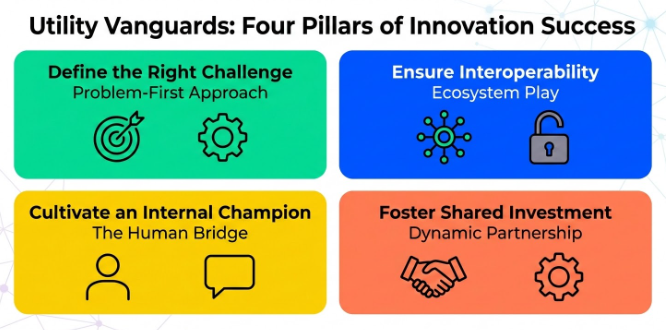
Here are four principles to keep in mind in utility-vendor partnerships to ensure a more seamless execution and better outcomes.
1. The Pivot from “Innovation” to Problem-Solving
Many utilities have established innovation mandates, yet many find themselves “solution-hunting” i.e. looking for a problem to fit a shiny new technology that they think will do x and y. Real value realization occurs only when the problem statement is rigid, but the execution is agile.
Take the evolution of one of Asia’s largest utilities. Their innovation journey involved a strategic investment. They focused on investing in Uplight, to use its software to solve the problem at the utility, which would bring value and help meet their decarbonisation goals. They tested this by running a demand response pilot in 2019, which today has scaled to 2 million customers, making it the largest demand response program in the world. By combining their financial investment with strategic use of software, they were tied to Uplight’s growth. A successful pilot that stays a pilot is a failure of innovation.
The lesson for vendors? Understand the incentive. When the utility partnered with Uplight, success wasn’t just about the code; it was about Uplight’s ability to meet stringent Measurement and Verification (M&V) targets linked to government incentive payments.
2. Interoperability: The Antidote to Vendor Lock-In
The modern grid has evolved into a hyper-dynamic ecosystem, moving far beyond a simple one-way flow of power. The rapid emergence of diverse Distributed Energy Resources (DERs), from residential storage batteries and bidirectional EV charging stations to smart water heaters, has created a complex web of edge assets that must be orchestrated in real-time.
Without seamless interoperability, these new assets remain invisible to the utility grid operator, creating volatility rather than flexibility. This shift is the primary driver of the industry’s move toward open protocols and integrated platforms; if a battery or an EV fleet cannot communicate across the stack, its value to the grid is lost.
When it comes to vendor selection, utility’s criteria have shifted toward ecosystem compatibility:
- Open Protocols: Adherence to SCADA, OpenADR, and IEEE 2030.5 is non-negotiable for future-proofing.
- Partnership Networks: The ability of a platform to integrate with a diverse range of OEMs from EV chargers to water heaters determines its long-term ceiling.
- Strategic Flexibility: A prime example is the partnership between Schneider Electric and Uplight. While they offer an integrated DERMS, the fact that Uplight maintains interoperability with other ADMS providers gives utilities the confidence that they are not becoming “locked in” to a single ecosystem.
3. The Human Architecture: Finding the Internal Champion
We often treat utility procurement as a purely technical exercise, but it is deeply human. The “economic buyer” (often leadership and exectives) and the “technical buyer” (program and implementation teams) speak different languages.
- The leadership team needs to see ROI, risk mitigation, and strategic alignment with decarbonization goals.
- The program and implementation teams need to know about ease of configuration, the integrations and how the algorithms perform during a peak event.
The key to a successful deployment is the Internal Champion. This is the individual who can bridge the gap, translating the vendor’s technical roadmap into the utility’s strategic vision. For vendors, finding this champion is often more critical than the demo itself. Product teams should own the communication line so that technical trust is built peer-to-peer, not just through a sales deck.
4. Beyond the Vendor-Client Relationship
The most resilient partnerships in this sector occur when the utility is investred in the project. When a utility is invested in the technology and relationship, as seen with many of the early adopters of Uplight, the dynamic shifts from a vendor-client relationship to a shared vision for the future.
For utilities evaluating new vendors, the checklist has evolved to move beyond the current feature set to also include:
- Founder and Investor pedigree: Does the vendor have the stability and financial backing to survive a 10-year utility cycle?
- Peer validation: If a solution is new, move beyond the public marketing. Request direct references to speak with existing customers about the day-to-day operational reality.
Platform success in the energy sector is measured by one metric: Scale. To realize long-term value, utilities must partner with vendors who are ready to adapt, grow through partnerships, and respect the absolute necessity of grid reliability.