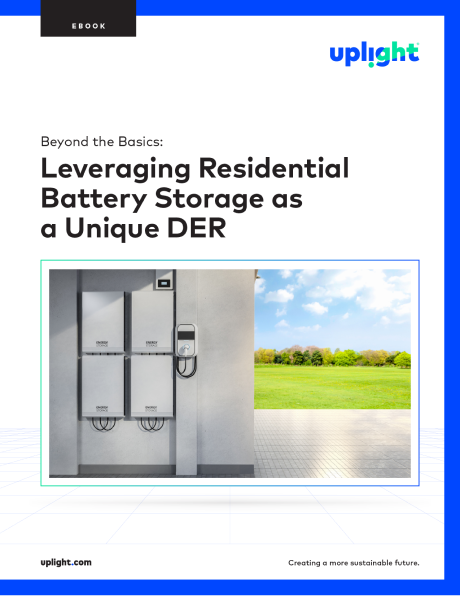
Residential batteries are quickly becoming one of the most versatile tools in a utility’s toolkit. They can shift load, manage peaks, support solar integration, and improve resilience. However, moving from pilot programs to large-scale deployment has been complicated.
To explore these challenges, Uplight recently hosted a working group with nearly 40 utility DER leaders to share experiences and lessons learned from early battery programs. The discussion offered insights into program design, operations, cost, incentives, and customer engagement, providing a unique view of how utilities are approaching residential batteries today.
To Own or Not to Own Battery Programs?
One important consideration of a battery program is device ownership. Utilities are weighing whether to own the batteries directly or support customer or third party owned systems, often called bring-your-own-battery (BYOB). Third party batteries make planning and procurement more predictable, with utility owned batteries allowing for direct capitalization, but they require significant upfront investment and ongoing operations. BYOB models, on the other hand, reduce costs for the utility and can accelerate adoption, but add complexity when it comes to customer support and device integration. Some programs are trying a mix of both—using utility owned assets while giving customers the flexibility to participate with their own systems.
Getting Battery Incentives Right
Upfront payments can get customers to enroll in programs, but long-term participation depends on performance-based incentives. Utilities are finding that combining a small enrollment bonus with rewards for measurable battery performance—often called “pay for performance” or “P4P”—encourages customers to keep the system engaged over time, while also making programs more cost-effective and easier to justify to regulators.
Telemetry is helping utilities design cost-effective pay-for-performance incentive structures. When batteries are paired with solar, it’s hard to know whether load reduction is coming from the battery or the solar panels. Telemetry data allows utilities to measure battery performance accurately, which makes performance-based incentives more reliable and defensible.
More Versatile, but More Complex
Batteries also introduce operational challenges that other DERs don’t. They touch multiple parts of a utility—planning, interconnection, and operations—and bidirectional power flows create new complexities around safety, dispatch, and metering. Programs need strong cross-department collaboration to avoid bottlenecks or underperformance. When batteries are paired with solar, the benefits multiply: energy generated during the day can be stored and used during evening peaks, helping to reduce strain on local infrastructure. Utilities are increasingly emphasizing this solar-plus-storage combination, both in program design and in how they communicate value to customers.
Making Batteries Equitable
Equity is another key consideration. Programs are exploring ways to encourage participation among low- and moderate-income customers while staying within regulatory guidelines. In rural areas, batteries serve a slightly different purpose: they improve resilience and can act as a non-wires alternative, delaying expensive infrastructure upgrades. Even when traditional cost-effectiveness metrics are harder to hit, these applications demonstrate clear community and grid benefits.
Customer recruitment remains a practical hurdle. Batteries are still seen as premium products, and signing up participants at scale—especially in LMI communities or regions with less solar adoption—is not easy. Utilities are experimenting with community outreach, partnerships with OEMs and installers, and streamlined enrollment to make participation easier.
Daily Load Shaping > Event-Based Control
There’s a shift among utilities toward daily load shifting rather than event-based control. Regular, predictable cycling not only delivers consistent value to the grid, but it also helps utilities better understand customer behavior. Programs that pair modest enrollment incentives with performance-based rewards are starting to show the best results for both engagement and operational reliability.
Residential Batteries as a Distinct DER
The takeaway from this working group is clear: residential batteries aren’t just another DER. They require thoughtful program design, cross-functional coordination, and careful measurement to unlock their full potential. Telemetry, performance-based incentives, and pairing with solar are emerging as critical components. When these elements are combined with equitable access, smart recruitment, and targeted rural applications, battery programs can deliver tangible, sustainable benefits for utilities and their customers alike.
Residential battery programs are still evolving, but the lessons shared during the Uplight working group point to a promising path forward: flexible ownership models, incentives that reward long-term performance, and strategic integration with solar can help utilities scale programs efficiently while meeting customer, regulatory, and operational goals. By sharing these insights, utilities are laying the groundwork for programs that are reliable, cost-effective, and widely accessible.