Picture a household at 3 pm. The thermostat starts pre-cooling the home. The battery sits idle, saving its charge for a time-of-use window. The electric vehicle starts charging during the exact hours the utility asked the household to conserve. The customer didn’t experience three optimized programs—they experienced siloed utility programs and inconsistent messaging.
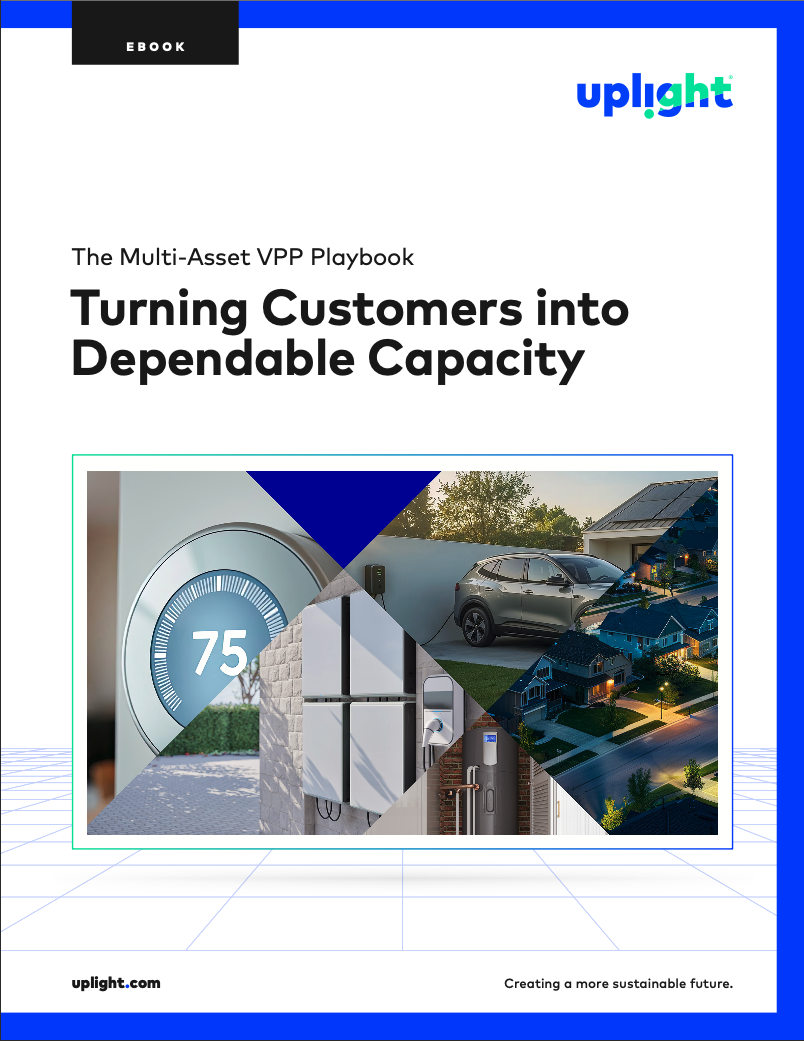
Coordinating devices like these as one portfolio is the idea behind a virtual power plant (VPP), which manages multiple distributed energy resource (DER) types and customer segments cohesively. Our new eBook, The Multi-Asset VPP Playbook: Turning Customers Into Dependable Capacity, looks at how utilities can put that idea into practice and build a resource they can plan around.
Customers feel the coordination gap
Households are already stacking devices, as three-quarters of electric vehicle (EV) owners own at least one other smart home device. The experience hasn’t kept pace: in our customer research, 62% of customers enrolled in multiple offerings described the process as disjointed.
Utilities earn capacity credit for duration and consistency
Markets are moving toward effective load carrying capability, a measure of how much of a resource’s reduction the grid can count on. The playbook cites a 2025 E3 study of the Southwest Power Pool showing that sustaining four hours per event earns approximately 83% credit in summer, compared with nearly 100% for sustaining 10 hours.
Markets also credit a portfolio at the floor of its delivery curve, not the peak. If a thermostat fleet sheds hard in hour one and fades by hour four, markets value it at hour four. The playbook explains how pairing thermostats with batteries and rotating short-duration assets can raise that floor.
The role of each asset in a VPP
no two asset classes have the same profile. The playbook examines what job each conducts best and what a utility can realistically count on from it.
-
Smart thermostats: the foundation. Thermostats offer the largest enrollable install base in most territories, delivering roughly 1 kW of shed per device during cooling events.
-
EVs and chargers: the energy shifters. When paired with time-of-use rates, EVs move large blocks of demand out of peak windows, though they’re a less reliable source of predictable capacity unless the fleet is carefully targeted.
-
Batteries: the anchor. Batteries respond in seconds with precise output and no customer discomfort, which lets utilities anchor firm commitments and offset the thermostat taper late in an event.
-
Water heaters and other flexible loads: the specialists. Water heater tanks work like thermal batteries for scheduled overnight load shifting, and traditional resistance units can also shed or add load within seconds.
-
Behavioral demand response: the widest door. Targeted messaging lets customers without connected devices participate, adding modest reductions per household that add up across the customer base.
How to design your VPP
For utilities designing multi-asset programs, the first question to ask isn’t “What assets should I add first?” It’s “What is your overall grid need?” The playbook finds there’s no universal answer to the first question, but grid needs can point to the right assets:
-
If you need peak capacity, pair thermostats with batteries for widespread shed and fast output, and add behavioral demand response for reach.
-
If you need energy shifting, pair electric vehicles with water heaters to move demand away from peak hours.
-
If you need fast reliability, pair batteries with water heaters, which can both respond within seconds.
Get more best practices from the eBook
Download the playbook to discover more about:
-
The role each asset plays in the portfolio
-
Ways to align assets with grid needs
-
Strategies for enrolling customers across assets
-
Incentive design, including paying for performance at the whole-home meter
-
Approaches to measuring and dispatching a mixed portfolio